
GPS Interview
Ola Mohajer
Founder & CEO, Transcend
MPA 2027, Brown University · October 19, 2026
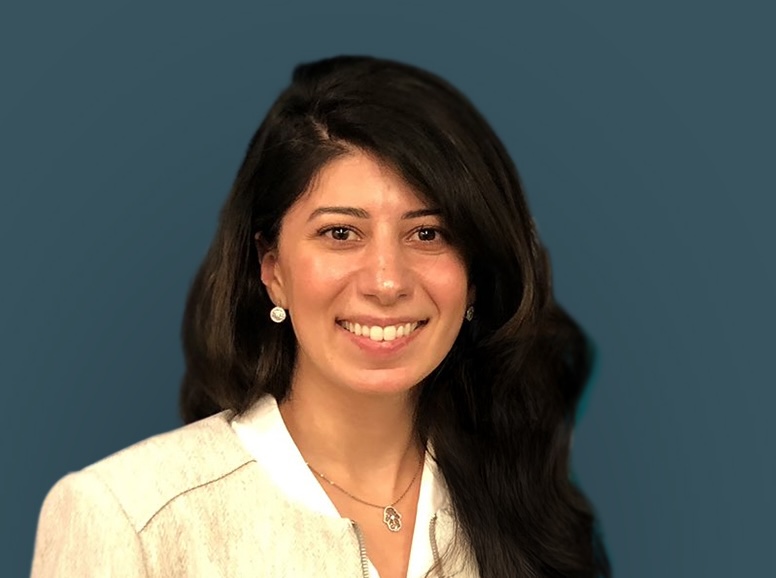
Ola Mohajer is the founder and CEO of Transcend, a Washington, DC based company that built an Artificial Intelligence (AI)-based platform for peace, national security and geopolitical risk. Before leading Transcend full time, she spent several years in diplomacy, conflict prevention, and stabilization, with a focus on Africa and the Middle East, including at the U.S. Institute of Peace, where she was the program officer for Sudan and South Sudan and later led the institute’s peacegaming program. She holds a master’s in international affairs from Columbia University. A former refugee and war survivor, she brings that experience to her work on how technology can support peace and security responsibly.
Mohajer spoke with MPA students at Brown University’s Watson School on October 19, 2026. The conversation has been edited and condensed for clarity.
Q1Why did you found Transcend, and what gap does it fill?
Transcend only exists out of passion and frustration: frustration coming from the sheer number of times that our analysis did not make the table for decision makers in time. Imagine a team of analysts with all their different expertise coming together to inform a decision. That’s months of work, and conflicts don’t wait for it. By the time it’s actually done and ready for absorption, the conflict has moved to another stage, and decision makers are operating in the gaps. Getting states around a table, willing to talk about an issue, is a human task to get political will. There’s a space in diplomacy called good offices that exists to do just this: get states to the table and keep them there. But an armed group doesn’t stop fighting just because you’ve been thinking about this for several months. Often, the context changed enough that political will had disappeared by the time solutions reached the table. Transcend solves that, or helps solve that, because our analysis is rapid. We can do everything from scenario planning to conflict analysis and stakeholder mapping. Instead of taking a few weeks or months, we do it in minutes. So we accelerate the work of diplomats, mediators, facilitators, and others, so that analysis meets the moment and they do not risk losing political will.
Q2How do you design AI platforms that help decision makers reason through uncertainty without creating false confidence or reducing their judgement to a single “best” option?
I’ll focus on two things. First, and what makes Transcend unique, we curate all the data that informs the analysis an agent outputs. Most AI companies don’t do this. We use high-quality data from sources like Afrobarometer, for example, if you need longitudinal results on almost any nation in Africa, and the World Bank, ACLED, CSIS, the U.S. Institute of Peace, and USAID—places where experts rely on the data. It is curated to produce what we call high confidence levels for analysis. Second, a lot of Transcend’s products are agentic, and agents have harnesses. Domain experts like me create the agents and the harnesses that govern them. What methods do agents use to produce analysis? How many sources must an agent pull to triangulate a single claim? What analytical rules govern an agent, as they would an intelligence analyst? All of that is deeply thought out and designed into our platform to increase confidence levels. We will never say that we offer anything at 100 percent confidence. It is really up to expert judgment to decide. Experts will have the final say, and one of the ways we ensure they can be confident in that final say is by making our platform auditable. If you’re working with an agent, you can see what the agent is thinking.
Q3Could you walk us through an example of your AI system in practice, with two opposing actors?
The most straightforward example, which I can talk about because we’ve discussed it on a panel, is a mediator going into a set of talks. That mediator asked us for a stakeholder map and a set of negotiation pathways for this conflict. Mediator teams are often under-resourced; sometimes they have no team. A live, always updated stakeholder map covers everyone from local through regional and international stakeholders, their interests, who funds them, and what stakes they have at the table. That matrix is large, and it takes time. On top of that, you need pathways for negotiating with the particular actors you happen to be sitting with, which at the time were, at the very least, the Rapid Support Forces and the Sudanese Armed Forces in Sudan. So now you have all these actors in your matrix, and different options for approaching a negotiation with these two actors based on the situation at that time. That had to do with access to humanitarian corridors, for example, and access to basic medical services. And then there was a disagreement about whether there was an ability to begin talks about a political resolution. The pathways would include those kinds of options, and then it would be up to the mediator to decide, which I think comes back to the question of: which pathway do they want to take, based on what’s unfolding at the table in person?
Q4AI models can show bias toward particular countries. How concerned are you that governments could unknowingly rely on AI that favors one side of a conflict, and how does Transcend approach this?
Point blank, I’m going to tell you: do not use frontier models, the LLMs like Claude and ChatGPT, for this kind of analysis, because they suffer from exactly what you’ve pointed out. Serious information asymmetry exists in conflict environments. Look at many conflicts, especially where there is an oppressed group or a group with fewer resources. The information that group has online is going to be minimal in comparison to the other party, and that yields the biased results you are seeing. We solve for this at Transcend in a lot of different ways. One I mentioned is how we curate data. Another is the agentic harness. And there’s more granular engineering work around retrieval: what information goes into an analysis and what doesn’t, and how you balance, to make it simple, Western and Eastern sources. If you have only Western sources on a conflict, a good analyst should say, “Hmm, I’m not sure about this one. I don’t see perspectives from this side.” There are a lot of good and famous analysts who do not do this, and so you see Western views perpetuated in how we are solving conflicts, and then we wonder why we’re not solving them.
Q5How do you protect a system like yours from manipulation, and do you worry that tools like this could speed up conflicts instead of preventing them?
The short answer is no. The longer answer is about security posture. These systems have to be secure, from how you design them to the security and compliance postures companies in this space should have. Precautions are simple, like rule-based access controls and least-privilege access. Practices like what information is retained, what is encrypted, how it looks in transit, and when it disappears are also critical to get right, because systems like this would attract others who may want to exploit or understand the information in them. Defense systems have many of these provisions, depending on the information used. Transcend follows all of these, with the goal of making our platform impenetrable.
Q6Could bringing AI into mediation compound a mediator’s perceived bias?
It’s really hard to say, because it depends on the kind of AI system that’s used. Given Transcend and our reputation, we’ve managed to build trust in our platform. If anything, I would go the other way: it might make a mediator see things they hadn’t considered before. At one point, even though we had gender-sensitive and youth-sensitive mediation guidance as a data source, one of our agents wasn’t picking it up. We’ve solved it through our testing. Now our system will point out a gendered lens, a youth-incorporating lens, and a disability-incorporating lens for mediation.